Christmas in Wing
One Christian's account of parish services and silencing social media

Being, post-confirmation, a regular churchgoer in our village of Wing, this year was the first in which I attended all of the Christmas Eve and Christmas Day services. I came away with two things: firstly, a profounder feeling for the meaning of Christmas, and secondly, a richer knowledge of the role that a church like All Saints in Wing plays within its community.
Christingle, our Rector Dom Wright explained at the Christmas Eve service of that name, is a relatively recent “tradition” in the UK. I cannot recall having heard of it before coming to Wing, a result, I suspect, of not previously being a regular churchgoer and also of not having children. The tradition arose from services held in Moravian church congregations in Germany in the mid-eighteenth century, and only spread to the British Isles in the 1960s. The Christingle itself is a curious, makeshift object - an orange wrapped with a red ribbon, with its top sliced open, a candle stuck in, and cocktail sticks with sweeties poking out of it. This has symbolic meaning: the orange is the world (let’s hope it never gets replaced with a Clockwork one), the ribbon the blood of Christ, the sweets the fruits of the earth.
At the service, the church’s lights are dimmed, and the candles are lit. In an ancient edifice such as All Saints, this creates a striking and evocative moment of pure theatre. For the adults, in any case. The children, of course, are more excited by the moment immediately following the candle being extinguished, when they can devour the “fruits.”
All Saints was rammed at the Christingle service. We have a regular congregation of between 25 and 35, so it was good to see upwards of 300 people packed into the church for this service. It is advertised around the local schools and community networks. People who would never usually come to church attend, as the occasion is magical, the children enjoy it, and there is a real sense of community in the space - a good proportion of the village’s primary-age children are there. Aside from the lighting of the Christingles, there is an improvised Nativity play, whereupon volunteers from the throng come on stage to represent the Holy Family, the Innkeeper, the Shepherds and Kings, and the barn animals. Some have dressed for the occasion in character. This ends up as a kind of controlled anarchy, as it both tells the story in a ramshackle way and gives the children opportunities for larks - this year, the boys playing the donkey were particularly tickled by their presence and performance. All in all, it is joyous to see, so long as those of us in the audience with a theatre background can suppress our craving for aesthetics in performance and stage tableau.
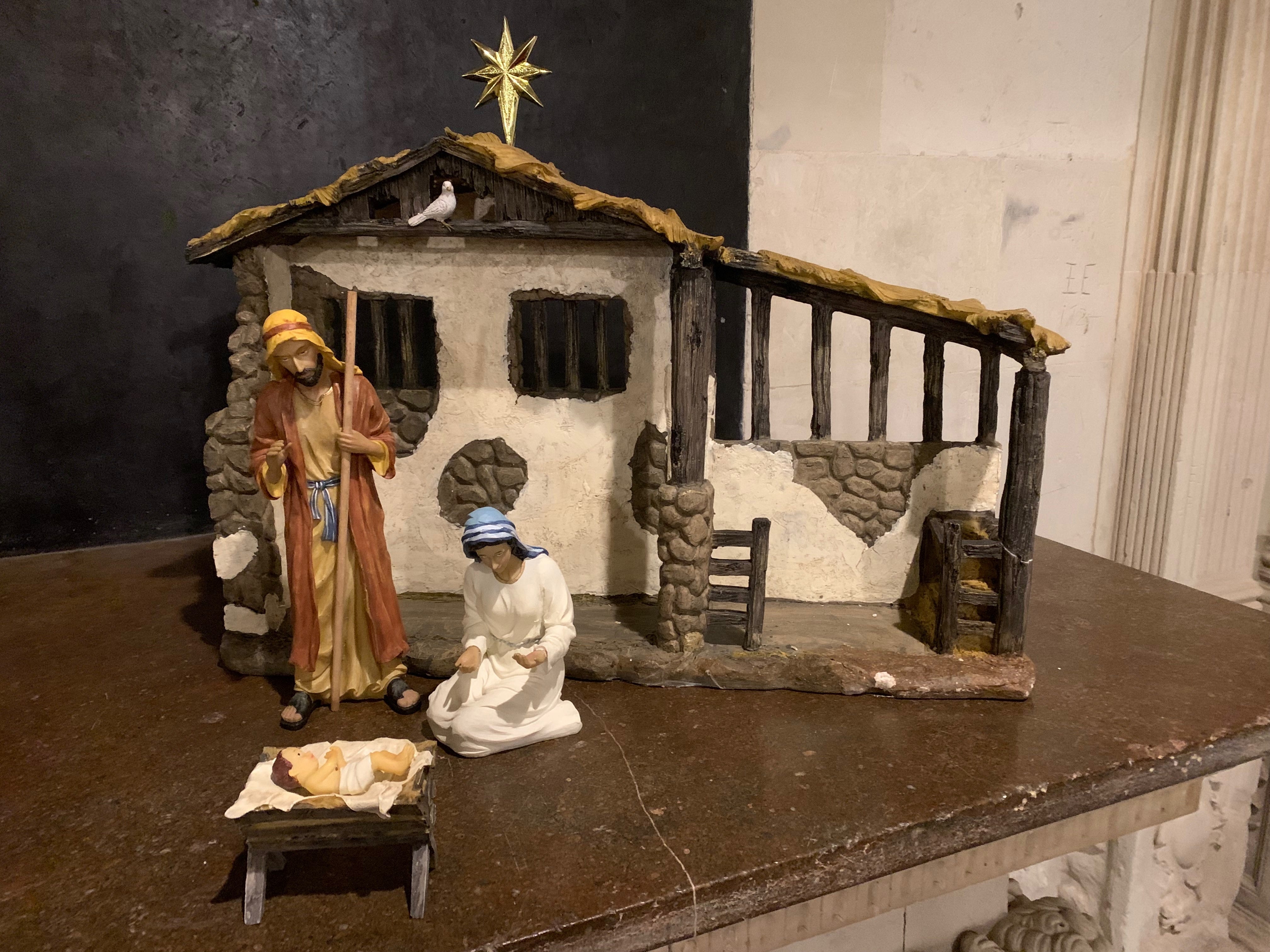
The minister tells the Christmas story throughout the service, punctuated by carols. I don’t know what it is with me and carols this year. I have always quite enjoyed them, but this year I found them almost overwhelmingly moving. As Bob Dylan recognised by recording an album of carols and other Christmas songs, these belong firmly to the folk tradition. I have tended to take them as sweet and memorable tokens of the season. My own preference has usually been for the Mark and John approach to the gospel, in which the Nativity is either not mentioned or elevated to mystical proportions. This year, though, the songs spoke to me of a particular historical event. They are very specific - “Once in Royal David’s City…” pins down a place; “While shepherds watched their flocks by night…” a time; “We Three Kings of Orient Are…” an origin. I confess that I have generally taken the Nativity as myth, but looking into it more closely, it seems that the earliest Christian communities were united in the conviction that Jesus was indeed born in Bethlehem.
Luke’s literary insertion of the census - which took place in 6 AD, after Herod the Great’s death, and which did not in fact require people to return to their ancestral hometowns - has encouraged a general scepticism about the entire story. Yet my haphazard investigation revealed that a number of scholars (including Joseph A. Fitzmyer, Raymond E. Brown, and James D. G. Dunn) regard the Nativity as an oral tradition. Across these and others, there is a broad convergence on several points: the Lukan Nativity material is early, not late; it contains personal, interior detail unlikely to arise from communal myth; the most plausible origin is Mary herself, either directly or through those who heard her; and Luke, as a careful compiler, likely spoke to eyewitnesses or received their testimony second-hand.
As I sang the carols, I had what I can only describe as moments of intense imaginative comprehension of the absolute singularity of the events being hymned. If the story of the shepherds is not made up - and why would people from a highly hierarchical society invent a tale in which angels initially choose lowly shepherds in a field? - then this is a once-in-history event, passed on by Mary to her family and circle at some later point: remembered, retold, and held alongside a life that would eventually unfold in public. Thoughts like these, running through my mind, make me sing heartily and weep freely. It reminded me of one of my favourite moments in Dylan’s interview with Bill Flanagan about that Christmas album:
BILL FLANAGAN: You really give a heroic performance of O’ LITTLE TOWN OF BETHLEHEM The way you do it reminds me a little of an Irish rebel song. There’s something almost defiant in the way you sing, “The hopes and fears of all the years are met in thee tonight.” I don’t want to put you on the spot, but you sure deliver that song like a true believer.
BOB DYLAN: Well, I am a true believer.
The children and their families left beaming, including my nephew, who was staying with us for Christmas. I found myself reflecting that many of the village children were probably christened in All Saints; some will be married here; some will attend family funerals; and some may even have their own funeral service in this church. A few, perhaps, will come to attend more regularly and come to recognise the One whom the church exists to serve. The church serves upwards, and outwards.
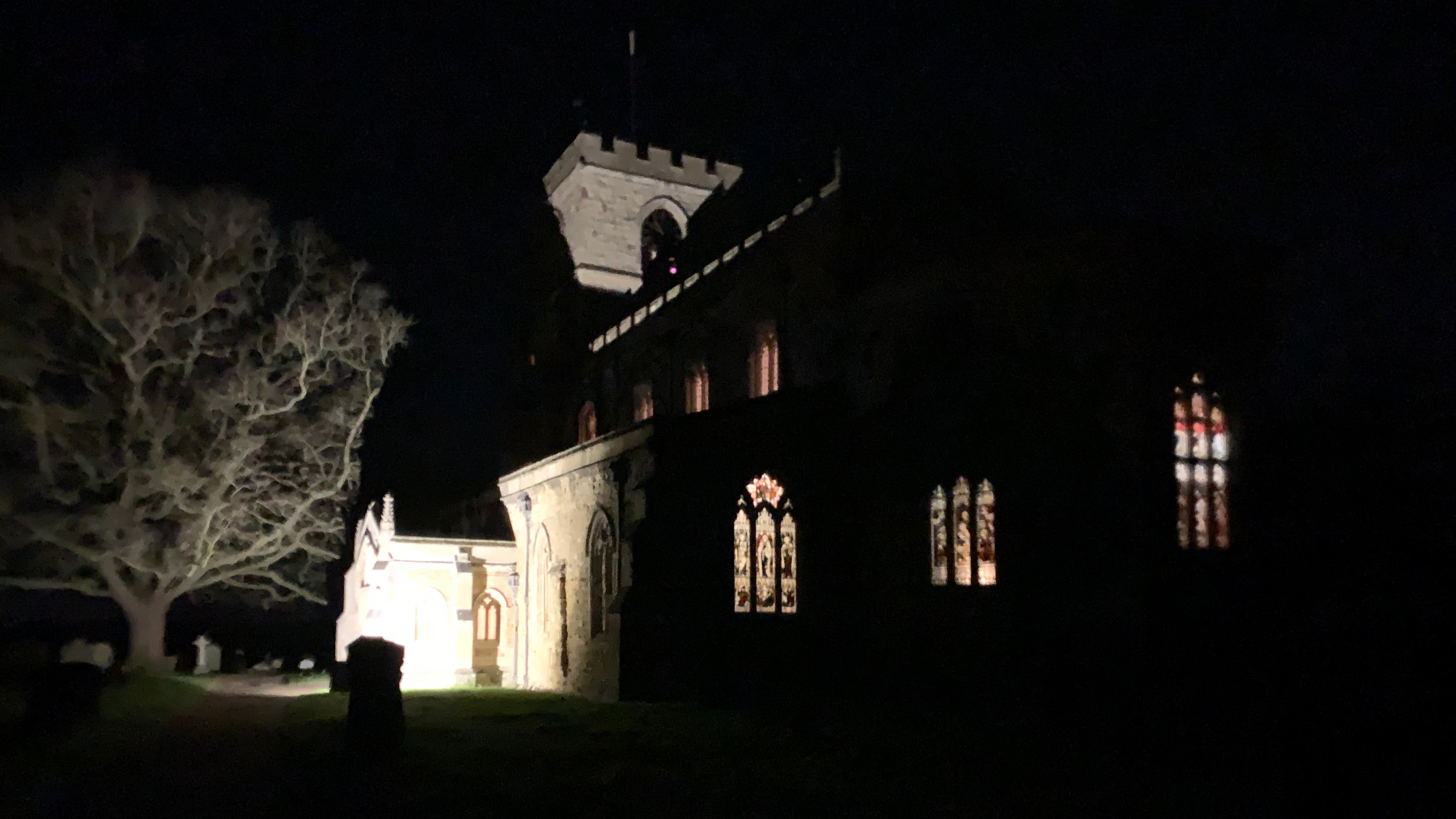
The Midnight Mass later the same evening was a more solemn occasion: not as packed as the Christingle, but with a fair smattering of faces we don’t see regularly. The service was a Holy Communion, preceded by a reflection on the extraordinary events in Bethlehem - events I was already turning over in my mind. Revd Dom let off some indoor fireworks to convey the attention-commanding shock of the angelic chorus that greeted the shepherds. Being at Midnight Mass in a rural village gives one a sense of being set apart from urban crowds and the city-sophisticated mind. It allows you to dwell on the idea of a small light shining in the dark. Stepping out into the biting air beneath a sky full of stars makes one grateful for the warmth of home, and awakens a sense of wonder at that home’s place in an enormous universe. My partner and I do not exchange gifts at Christmas. We feel as though we live within a gift.
The Christmas Day morning service brought some more new faces - villagers who attend only this particular service once a year, and young people home for the season or visiting relatives. It had the feel of a family service, which we managed to convey to our nephew, after his initial moans about being dragged along - “Really, on Christmas Day?!” - were steadfastly ignored. His face beaming during The Peace, and the fact that he had made, in the space of a week, some friends among the village children, reminded me how quickly a child’s attitude can change.
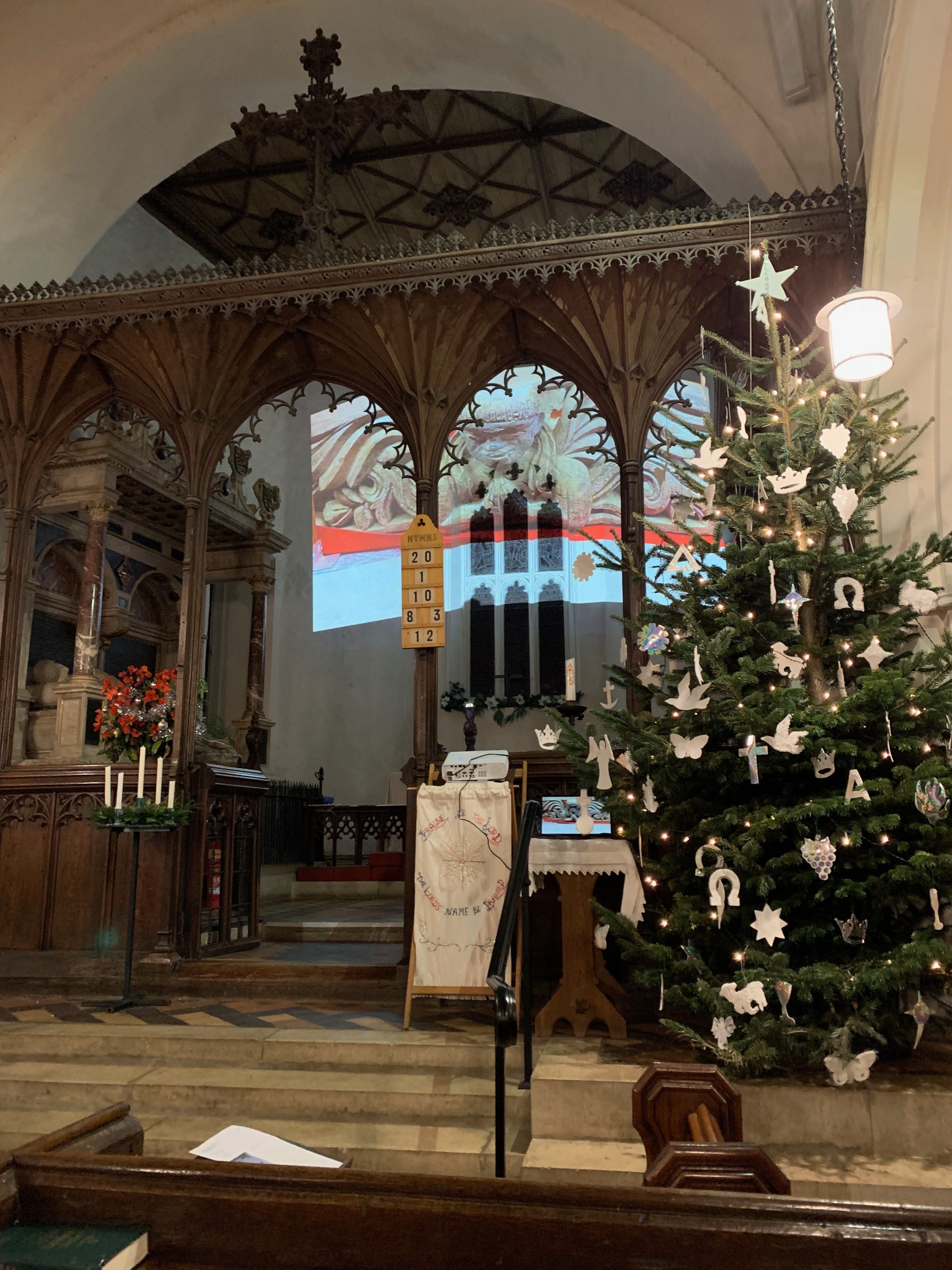
One of our occasional ministers, Revd Roger Hale, took the Christmas Day service. All the ministers have their own ways of doing things, and Roger uses a disarming humour - he could have been a stand-up comedian - to warm a congregation. But he is also capable of landing a blow. His sermon reminded us adults that Jesus does not remain a baby in the cot, and that Christ demands things that can feel dangerous and threatening to our sense of complacency. It was a strong message, and one I found myself receptive to, having spent some time over the season watching preachy children’s films. We are not meant to approach the Christian life in a childish fashion, even as we retain a childlike sense of wonder at a creation infused with the glory of God. The baby whose birth we celebrate grew into full humanity; the crucifixion is not a children’s story; and Christ is ultimately not a swaddled infant, but a Mighty God.
We returned home to prepare for more guests and watched the King’s speech. I was struck by the confident Christianity of the address. Filmed, unusually, in Westminster Abbey rather than Buckingham Palace, Charles was plainly asserting his role as head of our national Church. He referred explicitly to “Jesus, the saviour of the world” and to “the way our Lord lived and died”, and retold the Christmas story of The One who “came down to Earth from Heaven”, “whose shelter was a stable” and who shared his life with “the poor and lowly” - a pilgrimage “with a purpose, heralded by angels”. It was, I thought, the most upfront Christian Christmas speech I have heard from either this King or his mother.
You would not think so if you turned to X. According to one loudmouth:
King Charles used his Christmas message to gush about Islam, Judaism, Hinduism, and the ‘diversity of our communities’. He appealed to the Boomer mythology about the Second World War and ‘our values’ to overcome ‘division at home’. Give it a rest, it’s Christmas. Today is about Christ, our traditions, and not foreign religions or liberal platitudes. Take our side, for a change.
Another brayed, “I won the bet that ‘diversity is our strength’ would be used in the King’s speech.”
Except he didn’t. Charles did not use that phrase, nor does it paraphrase what he said. He used the word diversity once, in the following passage:
To this day, in times of uncertainty, these ways of living are treasured by all the great faiths and provide us with deep wells of hope: of resilience in the face of adversity; peace through forgiveness; simply getting to know our neighbours and, by showing respect to one another, creating new friendships.
Indeed, as our world seems to spin ever faster, our journeying may pause, to quieten our minds – in TS Eliot’s words ‘At the still point of the turning world’ – and allow our souls to renew.
In this, with the great diversity of our communities, we can find the strength to ensure that right triumphs over wrong.
When he said “In this”, he was referring back to the cluster of ideas in the preceding section - “these ways of living”. Only then does he add “with the great diversity of our communities”, which functions as a contextual modifier, not the subject of the sentence. The structure is straightforward:
Source of strength: moral virtues and ways of living
Setting in which they are practised: diverse communities
Outcome hoped for: right over wrong
The speech’s syntax and structure are perhaps a little more complex than we are now used to in contemporary media, but still, it is hardly the Four Quartets. Yet many people now seem unable to hold a sentence in the mind, let it unfold, and track what its pronouns and metaphors actually refer to. Instead, they listen for trigger words - diversity, in this case.
I have seen people argue on X that Charles was wrong to say “diversity is our strength”, or right to say it. That he did not say it does not seem to trouble any of them in the least. Charles’s use of diversity was descriptive, not programmatic. It was specific and challenging. He was not invoking virtues performed in a vacuum. He was saying that these virtues must be embodied within the messy, present reality of the diversity of our communities.
He did not label diversity as either good or bad, though many seemed desperate for him to do one or the other so they could cheer or howl accordingly. He simply named it as a brute fact.
I spend a fair amount of time on social media, and this year I have made some good, strong connections there. Sometimes, though, you do have to turn it off. There is too much bad faith, too much engagement farming, and too much rigidity of view. When it becomes overwhelming, I know I need to step away - and I hope everyone has a space untouched by that madding crowd, Eliot’s ‘still point of the turning world’.
This, for me, is the place of contemplation and prayer. This is the Kingdom. This is the royal city of Bethlehem, where Christ is born.