Patrick Bateman sings!
American Psycho as a musical

Does American Psycho need to be a musical? This, I would have thought, would have been the first question that occurred to the team of composer/lyricist Duncan Sheik and Roberto Aguirre-Sacasa as they set about adapting Bret Easton Ellis’s seminal 1991 novel.
The book is a notorious, nay infamous literary scandal which has turned, in the nature of these things, into a classic of its era and a set text. Nevertheless, anyone who has not read it should be warned that, as with the works of the Marquis de Sade, no distance of time and literary respectability can prepare the reader for the horrors within. Written (at length) in a deadpan, affectless voice, it follows a 1980s New York yuppie named Patrick Bateman who, alongside his job as an investment banker on Wall Street, pursues the lifestyle of a serial killer. Prostitutes, homeless people, neighbours, fellow bankers and gay men walking their poodles all succumb to Bateman’s murderous rampage, ending up stabbed, raped, mutilated, tortured, cannibalised, or subjected to necrophilia. All of this is related in endless pages of graphic detail, alongside Bateman’s accounts of his lifestyle, fitness, grooming and food regimes, designer clothing, and musical tastes. For the latter, he chews over the safest and blandest of tunes, and whole chapters float by in which he finds elaborate meaning in the facile output of Collins-era Genesis, Whitney Houston and, most hilariously, Huey Lewis and the News.
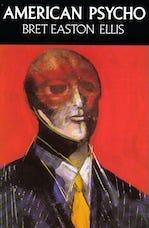
American Psycho is one of those books you would recommend to only a select few friends and colleagues. I bought it when it was first published and – enjoyed is not quite the word – found it exhilarating, challenging and very funny. There are chapters, such as the one entitled ‘Rat’, where you have to lay the book aside from time to time. It is a kind of satire – most obviously of corporate amorality, the commodification of human life, and Reaganomics – but it also goes beyond that. If the point were simply satirising capitalists, it would be made fairly quickly, and the great length at which it continues in the same vein would suggest it were a poor novel. Instead, the book becomes something closer to an ordeal for the reader. It constantly asks: why are you continuing to read this? What are you getting out of it? There is a kind of bravura in watching Ellis launch into yet another extended sequence of torture or fashion writing, but the book seems designed to drive any reader to the point of saying “enough already”. It becomes a cesspit, a whirlpool, a nihilistic abyss.
What complicates matters further – especially for anyone asking my initial question, “Does American Psychoneed to be a musical?” – is that there is precious little plot. There is some office flirtation between Bateman and his secretary, a will-he-or-won’t-he proposition of marriage between Bateman and his girlfriend Evelyn, and a lingering question as to whether the police will catch up with him after the murder of his arch-rival Paul Owen. Increasingly, there is also the question of whether any of this is happening at all. Ellis is, as those who have continued to read him will know, a rather meta writer. The ending resolves nothing. And so the question becomes more pointed still: does this almost unreadably repulsive, funny, plotless, perhaps entirely imagined book without a clear ending need to be a musical?
The team of Sheik and Aguirre-Sacasa answered the question in the affirmative, and the show opened, helmed by the British director Rupert Goold (famed for his excesses), at the Almeida Theatre in Islington in 2013, with Matt Smith playing Bateman. It was then produced on Broadway, where it proceeded to lose its producers a small fortune – such an obvious outcome that one suspects it was a Bialystock enterprise. The musical has now returned to the Almeida, where it concludes Goold’s tenure as artistic director. It was during this revival that yours truly got to see it.
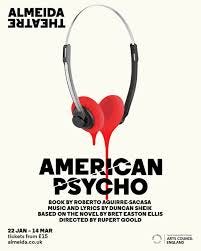
The writers have chosen to retain the book’s principal storytelling device and have Bateman narrate the show. Despite posters emblazoned with the adjective “bloody”, the story has been largely stripped of explicit depictions of murder and other atrocities, leaving us with Ellis’s gossamer storyline. Needless to say, an evening narrated by a charmless psychopath who does not even have the decency to entertain us with graphic violence is likely to disappoint readers of the novel. But then I am not sure the show is aimed at readers of the novel.
Instead, it presents itself – front, back and sides – as a satire on a materialist, competitive class of wealthy businessmen, soulless and empty, and assumes that this alone will sustain the evening. After all, we all agree how awful they are. So here is another example of what Howard Barker calls “the humanist theatre” – one where “we all really agree”, and where the audience’s virtue is confirmed as the evening progresses.
All of the book’s slavering misogyny has been excised. And to ensure that the liberal progressive audience bonds properly, the musical obligingly wheels on none other than the contemporary bogeyman Donald Trump. Trump is a pervasive presence in the novel as the New York entrepreneur and deal-maker par excellence – the man Bateman wishes he could be (Bateman cannot even secure the account he craves at work). Here, however, we get a jokey encounter with The Donald in an elevator which, alongside an earlier nod to “Jeff Epstein”, elicits that knowing, self-congratulatory laughter that is the speciality of this milieu.
American Psycho the musical is – comforting.
What of the music? As mentioned, the book spills a great deal of ink on Bateman’s musical obsessions, and as he stares into the abyss, the abyss sings back at him to the tune of Madonna’s Like a Prayer: “Life is a mystery / Everyone must stand alone...”. There might have been a case for turning the show into a kind of raspberry to the jukebox musical, with Bateman’s obsessions offering wry commentary on his escapades.
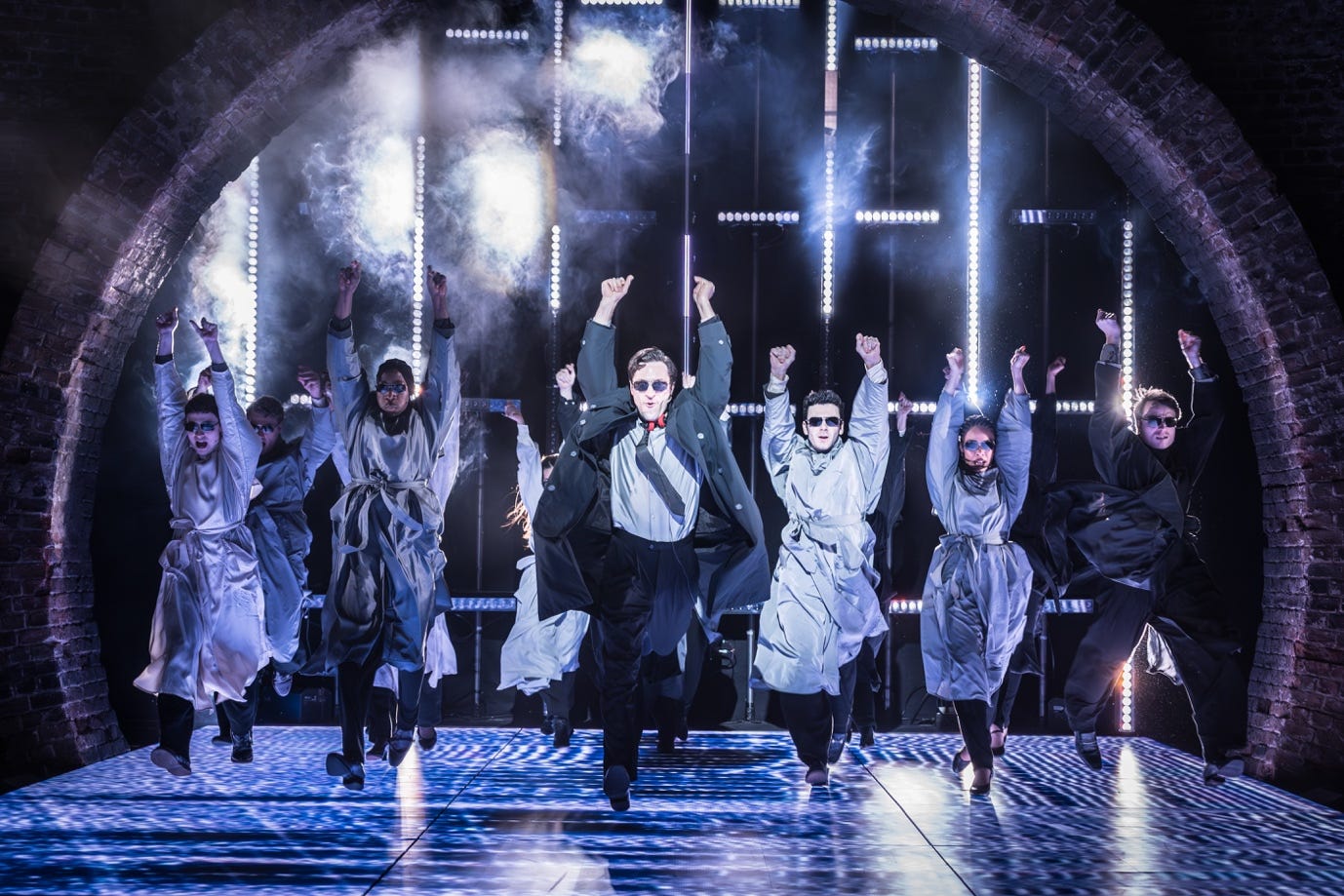
Instead, Sheik offers a set of songs about which it would be an exaggeration to say they are unmemorable – for that would suggest the tunes managed to penetrate the consciousness in the first place. The lyrics largely consist of SparkNotes commentary suitable for a sixth-form essay on the novel:
Even if this story
Is overwrought and gory
It’s not a fable, it’s not an allegory
No cautionary tale, no momento mori
Or a vague perhaps.
Ahem.
To make matters worse for himself, Sheik (or someone) has decided to insert several genuine 1980s hits into the show, and so his dribble has to sit beside Everybody Wants to Rule the World, In the Air Tonight, True Faith, Hip to Be Square and Don’t You Want Me. Alas, Like a Prayer does not make an appearance. But these numbers only emphasise the pointlessness and paucity of Sheik’s score.
I had actually forgotten he wrote the music, and it was only when consulting the programme at the dénouement that I remembered. This made me feel rather sad, because his musical of Spring Awakening was really rather good and contained some genuinely striking numbers. Perhaps the challenge of musicalising characters who are themselves ciphers within an uber-cipher’s mind proved too much for him. As it may have been for anyone, to be fair.
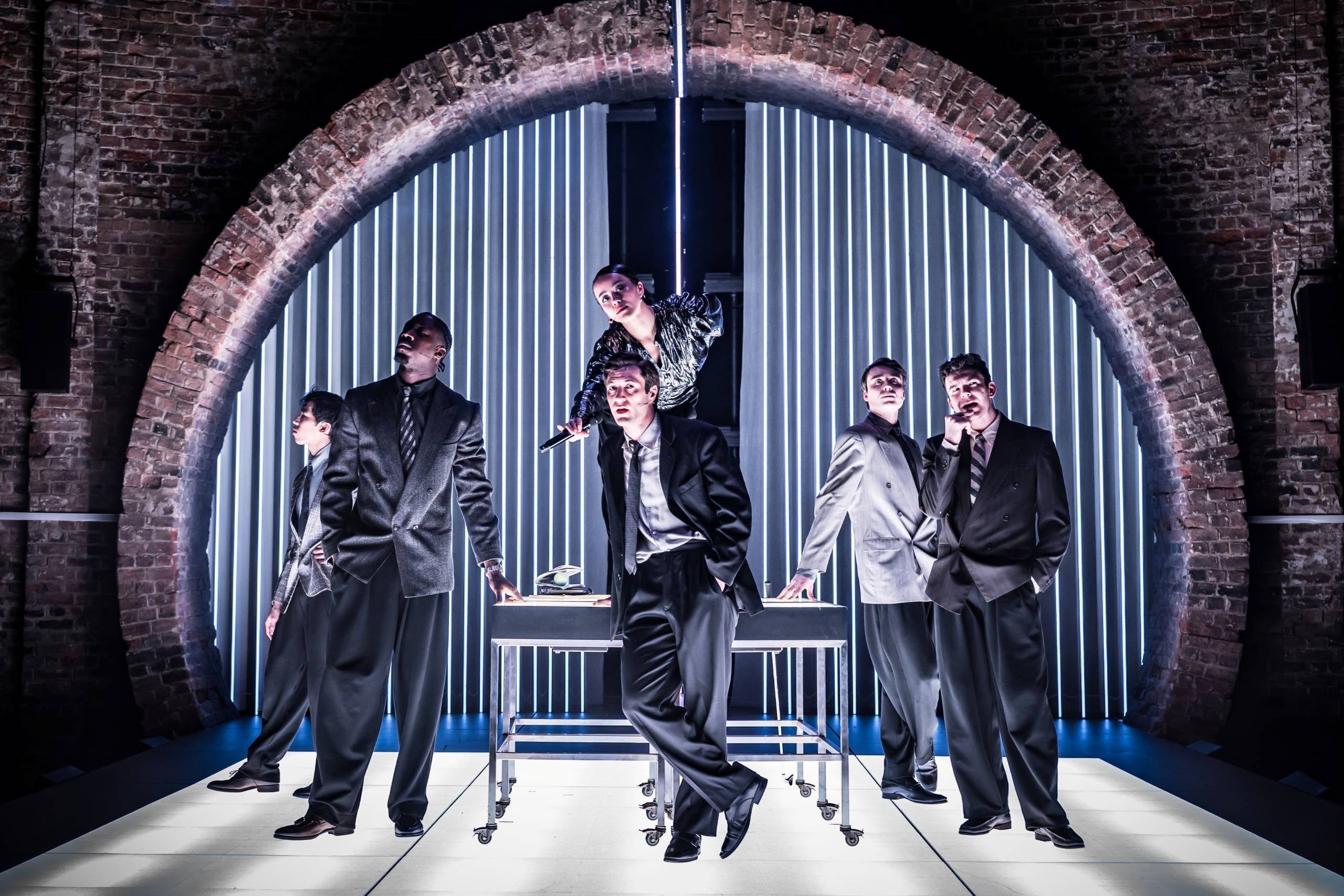
The show is slickly directed and designed. Goold is one of those directors – Ken Russell perhaps the progenitor – who does best when presented with material that can only be improved by his excesses. Given a classic, he tends to despoil it; given this kind of middling material, he manages to haul it onto the stage and somehow keep one watching even at its excessive length. I swear this ran longer than his recent Hamlet.
The cast are uniformly professional, though the lead comes across as giving what might politely be called a very accomplished understudy performance. The genuine star of the night is Oli Higginson as Bateman’s loudmouthed bestie Timothy Price – clearly an actor who throws everything into a role and is not afraid to go beyond mere professional sheen.
At one point, halfway through the first part of the evening, a stage manager came out and paused the performance “to deal with this situation we have in the row there.” This may be the first time I have heard the famous call, “Is there a doctor in the house?” An elderly gentleman was helped out of the auditorium. This would not have been a particularly pleasant show to die watching but, to be honest, it was nowhere near unpleasant enough.
To make a show of American Psycho you would have to challenge the patience of the audience – and not merely through incapacity. Its violence ought to make the bloodiest production of Titus Andronicus look like a fairground ride. If Bateman is going to speak to us, let us hear him drone on at length – the ideal production would run something like Gatz length. Otherwise there is a feeling – as here – that the makers have neither understood the source material nor approached it with due seriousness.
It ends up feeling like the thing Ellis was initially accused of writing: a kind of prank, a shameless attempt to be daring. If Ellis’s novel is a prank, it is a brilliant and lasting one. American Psycho: The Musical fails even as a jape.