The Correct Reaction
Learning what to think about John Proctor at the Royal Court

A friend texted me over the weekend to say he had a spare ticket for a new play at the Royal Court Theatre. In the mood for a small gamble, I went along to see John Proctor is the Villain. This is the London premiere of Kimberly Belflower’s play, which picked up a raft of Tony nominations on Broadway last year. As the title suggests, it offers a critique of The Crucible, Arthur Miller’s 1953 drama of the Salem witch trials, which itself had its London premiere at this venue in 1956. A theatre responding seventy years later to a play it once staged does rather suggest the fabled Oozlum bird – craning round to admire its own tail feathers and vanishing up its own arse.
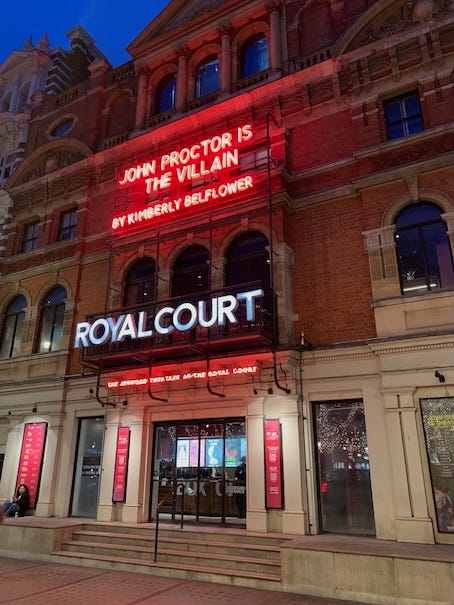
That said, some of the best theatre emerges in response to earlier works – most famously Rosencrantz and Guildenstern Are Dead by Tom Stoppard. At the Court itself, I admired Seven Lears by Howard Barker, while the theatre also premiered a Lear by Edward Bond. So hope springs eternal, even if it has to push its way through a plug of weary cynicism first.
I do get a fit of the heebie-jeebies going to the Royal Court. It is such a bastion of leftist theatre that, now I have broken cover as someone entirely unconvinced by progressive dogmas, it feels less like a night out and more like a reconnaissance mission deep inside enemy territory.

Sure enough, in the downstairs bar I was confronted with a gleaming new toilet arrangement, directing one either to TOILET CUBICLES WITH SHARED SINKS or to PRIVATE CUBICLES WITH INDIVIDUAL SINKS. How much simpler “Ladies” and “Gents” once were. I don’t recall these amenities on my last visit a year or so ago, so someone has clearly spunked a decent wedge entrenching this latest bit of ideological plumbing, even as the world outside shows the faintest signs of waking from the dream. Never let reality stand in the way of a good virtue signal.
No doubt they would be delighted to know that an old reactionary like me is clucking at the sight. After all, what is the point of a gesture if it does not provoke the correct response?
The correct response is, of course, precisely what I expect the plays at the Royal Court now to demand. On my last visit, I was hectored into sympathising with the murderous Raoul Moat. It was not always so. My first visit to this theatre was to see Victory: Choices in Reaction by Howard Barker – a play which, as its subtitle rather suggests, allows for something closer to thought than instruction. There is not much wriggle room in John Proctor is the Villain.
Spoilers ahead.
Belflower’s play is set in a high school classroom in a rural Georgia backwater in – and the script is very precise about this – 2018. What happened in 2018, class? Was someone horrible the President? Was it the thick of #MeToo? Was the horrible President the sort of man liable to #MeToo-type accusations? As Hong Kong Phooey used to say, “could be!” Having carefully fixed an indicative period, the play proceeds to deliver exactly the sort of drama one might expect.
Watching the play, it was not immediately clear how old the students were meant to be. Looking it up afterwards, I discovered they are what our American cousins call 11th graders – sixteen or seventeen. That at least explains the talk of college, though from their behaviour I had initially taken them to be somewhat younger.
These young folk are in a literature class studying, wouldn’t you know it, The Crucible. Their teacher is the distinctly crush-worthy Mr Smith – kind, supportive, and faintly in the mould of Dead Poets Society. He is Christian but progressive, and keen to instruct the class in the evils of McCarthyism – how lies destroy lives – and why John Proctor is a hero.
One particular girl, the brainy Beth, worships the ground Mr Smith walks on. Others arrive trailing their own subplots. Raelynn, an abstinent preacher’s daughter, is reeling after her best friend Shelby slept with her boyfriend and promptly vanished. Ivy, the rich girl, has troubles of a more reputational kind – her father is entangled in some sort of #MeToo scandal. Nell, a refugee from Atlanta, is present because… well, one rather suspects the cast list required it.
Diversity is an odd thing. One assumes that everyone at the Court is fully persuaded that it is our strength. Yet a glance around the auditorium suggested a rather less diverse reality. Such thoughts tend to arise when one is asked to sit through acres of dutiful exposition.
Soon – though not soon enough – Shelby returns from her mysterious sabbatical and, in what would once have been a first-act curtain, accuses Mr Smith of having had a sexual relationship with her. Well, he is white, male, and, worst of all, Christian, so I suppose he was obliged.
This being a contemporary play, our bladders are denied even the relief of an interval. The class, by now, is deep into The Crucible. There is also a feminist after-school club, of course. So we get a great deal of discussion about why Abigail dances in the moonlight, whether John Proctor is really as upright as SparkNotes would have it, and why Taylor Swift and Lorde count as feminist heroines. Let us say only that I am not the audience for this.
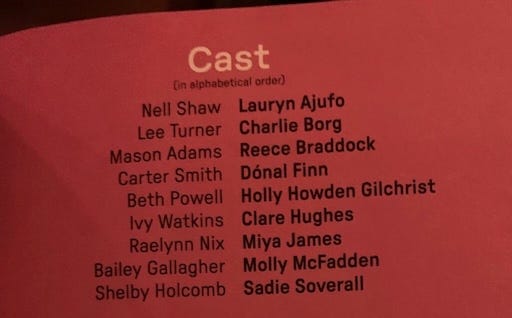
Something odd struck me when I looked at the cast list. The character names were on one side and the actors on the other, as usual – but one could easily have swapped them over, so little did the made-up appellations distinguish themselves from the actors’ actual names. It follows that the dialogue strives for the sound of actual speech – what it might be like to be damned to sit through a Georgia 11th-grade class.
Because bright young things do, in fact, talk – and, crucially, talk about things – this presents the playwright with a constant temptation simply to reproduce that discussion. Belflower cannot resist temptation. The result is dialogue that is neither poetic nor rhythmic, nor even especially interesting. Worse, the personalities of the characters are as uninspiring as their names.
There is the occasional funny line – I felt in danger of being lynched for laughing out loud at one of Lee’s more brazen sexist put-downs of Shelby – and I will grant the author that she allows him moments of genuinely amusing crassness. But as for language to admire, or an imagination to engage with, this is not the place.
There is, I must add, a glaring contrivance at the climax of the play. Mr Smith, having been accused, is nonetheless allowed to return and supervise the students’ presentations – including Shelby’s – on the basis of “insufficient evidence.” Even with a school counsellor in the room, this is dramatically risible. The scene exists not because it is plausible, but because the playwright requires it.
For the destination is never in doubt. Mr Smith is duly revealed – via the playwright’s gift for underlining – to be a villain. And, lest we forget it is 2018, we are treated to a solemn declaration from two of the girls that men in authority lie, a point which of course reflects back on the titular protagonist of The Crucible. Cue de rigueur standing ovation.
I confess I am no great admirer of Arthur Miller. I once came as close as I ever have to running amok, having sat through what felt like centuries of Death of a Salesman, only to emerge at the end and discover the West End’s bars were closed. Closer to the matter in hand, I was once threatened with violence by a left-wing actor when, in my cups, I suggested that so verbose and dreary was Proctor that he might well deserve to be hung. Such were evenings in theatrical company in one’s gay youth.
Yet for all that, The Crucible at least permits a degree of ambiguity. Miller clearly intends Proctor to be admirable, but he is sufficiently realised to sustain a less flattering view. Perhaps the worst thing one can say about John Proctor is the Villain is that it forecloses entirely the possibility of a response entitled Mr Smith is the Hero.
When this played in NYC someone told me it was good. I had a feeling from the title I knew exactly what it was about and would not enjoy it. If you dare to even think the words “The Crucible” around a certain type of theater person in NYC you will get a lecture on so-called “toxic masculinity” or “patriarchal systems of oppression.” Sadly, new work in the U.S. is only supported if it conforms to addressing a certain set of ideas, if a work tried to address other ideas or (gasp!) criticize the dogma, the work won’t get grant funding or institutional support. Worse, those of us attempting to get support outside of captured funding streams can’t find support from alternate sources because the right in the U.S. isn’t interested in the arts—though they should be if they cared about culture.