The Dirty Harry Problem
Vigilante films, international law, and the war with Iran

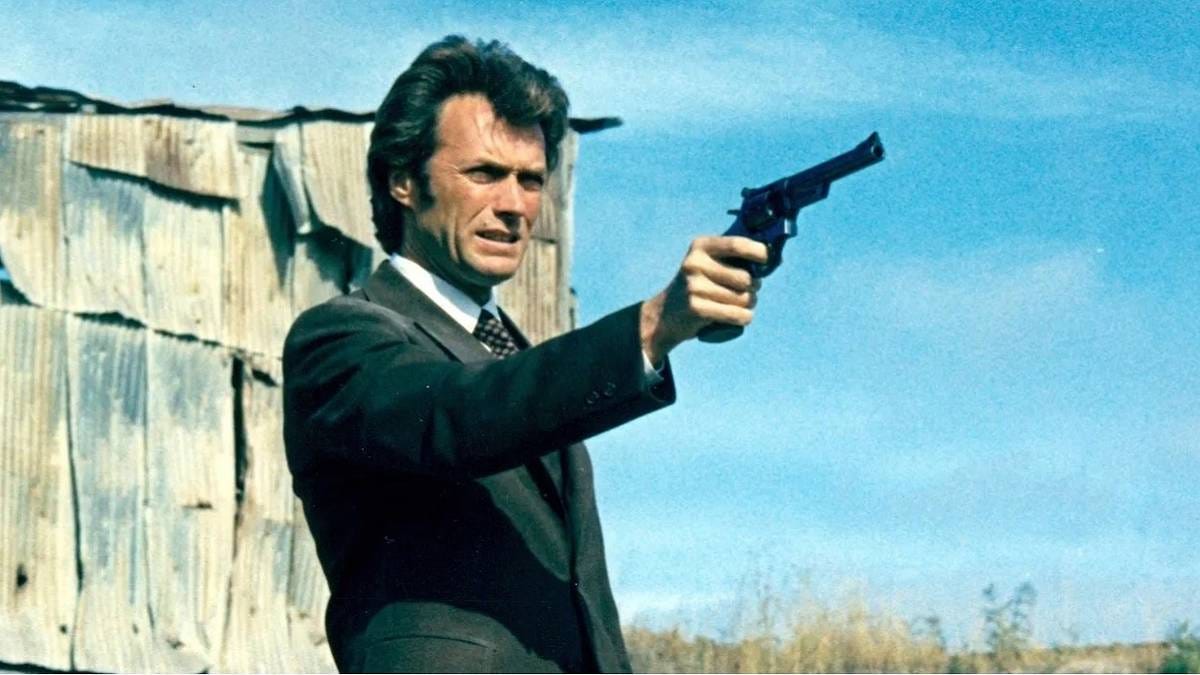
I love vigilante films. I love them because they tell us something we do not like to hear. The gold standard remains Dirty Harry, in which Clint Eastwood’s professional cop ends up throwing away his badge after turning vigilante. I am also fascinated by Charles Bronson’s various contributions to the genre – in the Death Wish franchise, of course, but also in the series of morally murky and cinematically disreputable exploitation pictures he made with the English director J. Lee Thompson in the 1980s, from 10 to Midnight through to the eye-popping Kinjite: Forbidden Subjects. This week I have found myself thinking about this critically maligned genre in relation to the current war between the USA and Israel and Iran.
The thorny problems raised by this war have been brought into focus by an article in the Telegraph by Nigel Biggar, followed by a letter responding to it from the Bishop of Chelmsford, the Rt Rev Dr Guli Francis-Dehqani. The disagreement turns on the vexed question of International Law. In brief, Biggar argues that Britain should not treat the opinion of lawyers about the UN Charter as the final word on whether military intervention is right. International law, he submits, can sometimes fail morally: the veto structure of the UN can prevent action even in situations of grave injustice. Governments therefore cannot outsource moral responsibility to legal rules alone. Even if a war were technically illegal, it might still be morally justified. (Don’t shoot the messenger, by the way – I am merely summarising). In the course of making his argument, Biggar mentions an Iranian school friend, Bahram Dehqani-Tafti, who was murdered by the Revolutionary Guard in 1980 “because his father was the country’s Anglican bishop,” before going on to list many of the atrocities carried out by the Islamic regime in the years since.
The Bishop of Chelmsford – Bahram’s sister – responded with some astringency in the letters column. While acknowledging Biggar’s memory of her brother, she objects strongly to his use of the assassination in support of the current war. In her view the conflict is a war of choice rather than necessity. Although the Iranian regime is “odious and repugnant”, she argues that it posed no imminent threat that could justify pre-emptive self-defence. Diplomacy, while slow and frustrating, had not been exhausted, and international law exists precisely to prevent states from resorting to force in such circumstances. Finally, she insists that her brother’s memory should not be invoked in support of the war.
Here, in the space of an opinion column and a letter in reply, we see the tenor of the to-and-fro between those supporting and opposing the American and Israeli attack on Iran. Now to vigilante films.
The classic structure of a vigilante film follows something like this narrative arrangement: wrongdoing occurs – often an act or acts of extreme or shocking violence perpetrated against an innocent person or persons. Then, institutions fail. The police, the courts, or politicians prove ineffective or constrained, and the wrongdoer remains at large, usually to continue doing his campaign of wrongs. This pushes the victim (or a righteously driven proxy) to take action that is, to understate the usual case, somewhat outside the law, and which itself contains a considerable amount of extreme and shocking violence to the person of the wrongdoer and any cohorts. The audience is invited to ponder on whether this illegality was justified.
Yet these films do more than allow their audience a disinterested ponder. We see and feel the crimes of the perpetrator in graphic detail. We experience the terror of the children whose bus has been hijacked by Scorpio in Dirty Harry; we witness, with revulsion, the terrible and animalistic sexual assaults in films such as The Big Racket and Death Wish II; we hear the wanton indecency with which the pimp Sport describes the acts his twelve-year-old child prostitute will perform for those who buy her in Taxi Driver. The visceral power of these films lies in the fact that they leave viewers in no state of innocence about the depravity of the wrongdoers.
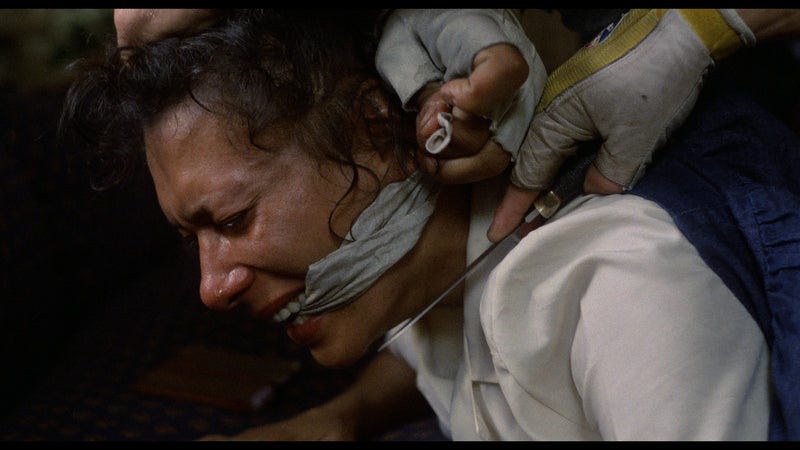
Traditionally, neither do the films deny us the gratification of the wrongdoer finally getting theirs. Multiple de rigueur scenes of the protagonist being frustrated by the unwillingness – or, more often than not, the inability – of the law to act lead us to experience that frustration ourselves, and to wish, in empathy, that there were some way to ensure that justice be done. These scenes are important, because they encapsulate something of Biggar’s argument: here we have law which has ceased to be justice; law which, if not in intention then in effect, protects the wrongdoer rather than providing justice to the wronged. When Harry Callahan or Paul Kersey eventually pick up their guns and deal with the situation, the audience feels a huge sense of relief that justice has finally been done. On the release of the first Death Wish, cinema-goers famously cheered when Kersey shot the muggers – much as many, it must be acknowledged, now cheer the destruction of Iran’s ruling command.
Yet some of these films introduce a certain ambiguity around the violence of their protagonists. Despite the abhorrence audiences feel towards Travis Bickle’s targets at the climax of Taxi Driver, Scorsese does all he can to work against any euphoria about the violence – fingers shot off, arteries spraying blood. In Kinjite: Forbidden Subjects, it is very difficult to unequivocally celebrate policeman protagonist Crowe sexually torturing a child trafficker with a sex toy. The genre often feels distinctly queasy about vigilante violence. In the undeservedly obscure Vigilante Force, a small-town cop, Ben, his pleas to his superiors ignored, calls on his Vietnam veteran brother Aaron to help deal with local hoods, assisted by a hastily assembled army of fellow vets. It proves a bad idea. Aaron is a corrupt psychopath, and the film becomes a parable of how something like fascism can arise when the authorities fail to maintain law and order.
This uneasy three-way relationship between criminality, ineffective law, and justice is the thorny and seemingly unsquarable circle around which these films run. It is also very much the problem that lies behind the missives of both Biggar and the Bishop. A short scene in David Fincher’s Zodiac brings the tension into focus. Struggling to discover the identity of the real-life killer of the title (whose reign of terror helped inspire the creation of Dirty Harry’s Scorpio), detective Dave Toschi takes a night off to visit the cinema. What should be on screen but Dirty Harry itself. In the lobby afterwards he meets the mayor, who quips, “Hey, that Harry Callahan did a hell of a job with your case.” Toschi replies, “Yeah, no need for due process, right?”
The narrative structure of Zodiac complicates this dismissal. The film forensically uncovers the impotence of procedure. The detectives are scrupulous about warrants, evidence, jurisdiction and due process. Yet despite years of painstaking and by-the-book investigations, they never solve the case. The killer simply disappears through the system’s gaps. The film ends not with justice, but with a kind of existential frustration of justice.
Biggar’s argument is that the system of International Law potentially leads to a similar, but far higher-stakes, existential stalemate. Tyrants such as the mullahs of Iran get to merrily cause havoc, murdering its own citizens, attacking Israel via their proxies who run riot across Gaza, Lebanon and Yemen, while the regime sponsors endless international terrorism. Just because some fine line of International Law does not deem such a toxic presence an “imminent threat”, must it be tolerated? What of its hundreds of thousands of victims?
Yet even Biggar admits that intervention could go pear-shaped. “The attacks on Iran may be imprudent,” he writes. “They may be ill-fitted to achieve their aims. They may fail to topple the atrocious regime or fail to replace it with anything better.” In the face of an ineffective legal structure, American and Israeli leaders are left with the decision whether to take the law into their own hands. It is by no means a situation with easy answers.
Vigilante films are dismissed by mainstream liberal humanist critics, who see them as appealing to the worst sides of human nature: revelling in violence, making lawlessness heroic, and offering simplistic answers. There may be some truth in this. Yet these films also acknowledge human nature’s darker impulses; they recognise that violence may sometimes be met with violence; they are frank about the limitations of legalism; and, crucially, they refuse to offer neat answers to situations that may in fact be intractable.
In Joseph Campbell’s account of what he calls the monomyth in The Hero with a Thousand Faces, the second stage of the hero’s journey is the “refusal of the call.” Here the hero hesitates or refuses the summons to adventure out of fear, uncertainty or obligation. Yet the refusal does not make the problem disappear; on the contrary, it usually makes the situation more restrictive or unbearable. The call in our own moment is not necessarily to beat the drums of war, nor to protest those who do. It may instead be to face the more uncomfortable truth that some situations offer no simple division between right and wrong. Many of our fellow human beings will die violently and prematurely either way – and so might we ourselves.

In the Bhagavad Gita, Arjuna asks Krishna, on the eve of a cataclysmic war, whether it is right for him to fight an enemy force made up of his own relatives, teachers and friends. Krishna does not offer an easy answer, but redirects him towards a deeper reckoning within.
Or, as those of us that are Christians say, knowing something of humanity’s inability to solve its own problems: let us pray.